Global consensuses can be plural

With all due respect to Peter Beinart, I think he gets this one wrong:

And that means you can either forge truly global institutions—which include Moscow and Beijing—or you can forge institutions whose members genuinely respect freedom. You can’t do both. Similarly, it would be nice if there were a global consensus that nuclear proliferation was bad, but there’s not. Countries with nukes mostly think that no one else should enter the club. Lots of countries without nukes want in.

It’s all well and good to say that we can have different kinds of international institutions for different issues: global ones where there really is a moral consensus; limited ones where there is not. But in the real world, you can’t keep things so separate. The more you alienate non-democracies by creating powerful new institutions on human rights, the harder it is to get their cooperation on issues of common concern.

This reminds me of the tired debate about creating a "League of Democracies." On the one hand, Beinart is right that pushing for such a provocative (and ill-defined) "pro-freedom" institution will only make global cooperation more difficult. But on the other, different global institutions do exist. The role of the UN is not undermined by the existence of NATO, nor is the World Bank's by the G-8 or G-20.  Advocating human rights through the Human Rights Council does not impede the work of the International Atomic Energy Agency.

Moreover, the fact that all countries in a global institution don't agree on something does not mean that the institution itself is useless, even at tackling a problem on which its members have differing viewpoints. The UN and other mixed groups of countries are proper venues for negotiating nuclear nonproliferation precisely because they contain both countries with and without nukes, and whose commitments toward nonproliferation vary. You can't come to an agreement on something in a group in which everyone already agrees. "Forging" a global consensus is difficult work; you can't just corral the right countries into the right groups. But that doesn't mean we shouldn't try, even on aims that might seem to be at odds with one another.

On the eve of Hillary Clinton's trip, an insider's look at the Indian political scene

By eriposte:

Eriposte is a regular contributor to The Left Coaster, where he frequently writes on issues pertaining to the Indian sub-continent. In his previous contribution to UN Dispatch, eriposte wrote about the link betweem rural poverty and extremism in Pakistan. 

Secretary of State Hillary Clinton will be in India from July 17 through July 21, visiting both Mumbai and New Delhi. This is a trip aimed at laying a foundation for a deeper and more strategic engagement with India. Interestingly, one of the leading Indian newspapers The Hindu reports that in Mumbai, "she will be staying at the Taj Mahal Hotel in an act of solidarity with the 26/11 victims" - a reference to one of the major sites targeted in the coordinated terrorist attacks last year (26/11).

Clinton will not visit Pakistan during this trip, implicitly sending a message that the United States no longer views India merely "through the Pakistan lens" - a message that was also indirectly conveyed earlier by eliminating India from the charter of Special Envoy Richard Holbrooke. In a recent speech, Secretary Clinton said "We see India as one of a few key partners worldwide who will help us shape the 21st century" and characterized this period as "a third era...U.S.-India 3.0". Some of topics that are expected to be discussed during her trip include global security, nuclear energy, climate change, trade and human development. Given the significance of this trip to US-India relations, this might be an appropriate moment to highlight some of the key players in India when it comes to foreign policy.

U.S. Still in Denial on Gender Violence

This is welcome news:

The Obama administration has opened the way for foreign women who are victims of severe domestic beatings and sexual abuse to receive asylum in the United States. The action reverses a Bush administration stance in a protracted and passionate legal battle over the possibilities for battered women to become refugees.

But one sentence caught my eye:

In addition to meeting other strict conditions for asylum, abused women will need to show that they are treated by their abuser as subordinates and little better than property, according to an immigration court filing by the administration, and that domestic abuse is widely tolerated in their country.

Are we kidding ourselves? Name a country, including the U.S., where domestic abuse isn't widely tolerated.

In the words of the WHO, "Gender-based violence, or violence against women (VAW), is a major public health and human rights problem throughout the world."

Here's a chilling video in which Keira Knightley reenacts the vicious and cowardly abuse women are subjected to on a daily basis:

Morning Coffee - 16 July 2009

Welcome to Morning Coffee, brought to you by Lindsay Beyerstein with additional links from the UN Dispatch team. Every morning we survey foreign affairs and foreign policy news so you don't have to. We begin with the "Starting Five" items of the day -- these may not always appear on A-1, but they *are* the kinds of stories that will be buzzing in foreign capitals, the UN and wherever foreign policy minds roam.
Starting Five
RUSSIAN RIGHTS ACTIVIST MURDERED - Russian human rights Natalia Estemirova was kidnapped and murdered in the North Caucasus yesterday. Estemirova was abducted near her home in Chechnya and her body was found in Ingushetia. She had been investigating human rights abuses for the Memorial Group, an independent human rights organization. Estemirova was the recipient of the first Anna Politkovskaya Award, established to honor the memory of the Russian journalist who was gunned down while reporting on human rights abuses during Moscow's decade-long anti-terrorism campaign in Chechnya. Link
STILL UN-EQUAL? - UN Deputy Secretary-General Asha-Rose Migiro challenged the United Nations to lead the way on gender equity by exemplifying the values it advocates. Migiro told the Group on Equal Rights for Women in the UN (GERWUN) that women remain underrepresented in some of the organization's most important missions, including political affairs and peacekeeping. Link
NARCOTECTURE - Lifestyles of the rich and predatory. Journalist P.J. Tobia presents an unusual photo tour of "narcotecture," also known as the poppy palaces of Afghanistan. These are the heavily guarded homes of drug traffickers who have grown fat from the proceeds of the best opium harvest in history. These dwellings are remarkable for their opulence and their sheer ugliness. Tobia suspects that misappropriated USAID dollars may be subsidizing some of those ornate balcony railings and imitation Greek pillars. Link

Sanctions tightening around North Korea

The facts that China appears to be on board -- not to mention that the UN panel on North Korea sanctions may come to consensus before its deadline -- do not bode well for a defiant Pyongyang.

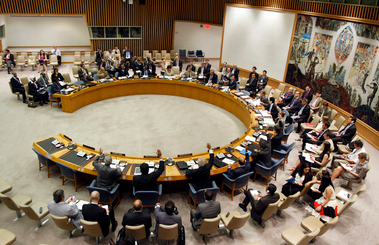
The U.N. Security Council neared agreement on Wednesday on North Korean firms and individuals to be added to a blacklist for involvement in Pyongyang's nuclear and missile programs, diplomats said

"We are very close" to agreement, Japanese Ambassador Yukio Takasu told reporters. Diplomats from several countries said a council committee that has been discussing the issue for a month was on target to meet a weekend deadline for completing its task and could do so as early as Wednesday.

Meanwhile, North Korea insists that its "sovereignty" be respected before negotiations can recommence. This seems to have it completely backwards. North Korea's leaders aren't exactly the ones to place conditions here; they're the ones who will need to reconsider their country's nuclear program if they are interested in, say, having unfrozen bank accounts or being able to travel anywhere.

Yet I wouldn't be surprised to hear some off-the-mark commentators continue to insist that an utterly isolated North Korea somehow has "the upper hand" in this drama.

The "continued vitality and relevance" of certain international institutions are questioned Clinton's speech

John captured one good quote below.  Here's  another I jotted down. Sayeth the Secretary: "We are seeking institutions that combine efficiency and capacity for action with inclusiveness...Their continued vitality and relevance depend on their legitimacy and representativeness--and the ability of their members to act swiftly and responsibly when problems arise. "

The UN as a whole has the legitimacy and relevance part covered. And various UN agencies like the World Food Program, World Heath Organization and UNICEF have the "swiftness of action" down pat.  The Security Council, however, sometimes lacks a bit of both criteria. I wonder, therefore, if a statement like this is meant to lay the groundwork for a new push on Security Council reform? 

July Already the Deadliest Month for Foreign Troops in Afghanistan

A harbinger of things to come or a temporary spike?

The death toll for foreign troops in Afghanistan halfway through July equalled the highest for any month of the eight-year-old war, tallies showed on Wednesday, as a U.S. escalation has met unprecedented violence.

Authorities announced a U.S. soldier had been killed by a bomb and two Turks had died in a road accident, raising the toll of U.S. and allied foreign fatalities in the first half of July to 46, equal to full month highs set in August and June 2008.

In the two weeks since U.S. and British troops launched massive assaults, Western troops have died at an average rate of three a day, nearing the tempo of the bloodiest days in Iraq and almost 20 times the rate in Afghanistan from 2001-04.

Happy 60th, Geneva Conventions

On the 60th anniversary of the Geneva Conventions, it seems appropriate to celebrate the possibility that the United States could firm up its compliance with another UN human rights mechanism, the 1984 Convention Against Torture and Other Cruel, Inhuman or Degrading Treatment of Punishment.  U.S. Attorney General Eric Holder is reportedly considering launching an investigation of the use of torture during the Bush Administration, a step that President Obama had been loathe to take.

IntLawGrrls' Beth Van Schaack has much more on why the U.S. should be fully implementing the Torture Convention, so I'll just add my agreement that this is a good step both for international justice and for the United States itself.  The politics of an investigation will hopefully fade eventually, as this should be far more an issue of policy -- of making sure the United States is abiding by conventions it has agreed to -- than a partisan tactic.

Obama answers Africans' questions

This is pretty cool.  Via Passport, the White House just posted a video response to three questions submitted to President Obama from African cell phone users.     

Post-previewing Clinton's speech

Previewed yesterday, here's a bit of a post-preview, if you will, of Hillary Clinton's speech at the Council on Foreign Relations today (just about over now), mostly courtesy of our friends on the FP blogging team.  Laura Rozen had some excerpts of the speech before Clinton even gave it; WaPo's Glenn Kessler looks at the Iran bits; Josh Keating couldn't find it on the teevee; and Dan Drezner has a great play-by-play for those who (like me) missed it.

The key graf for fans of international cooperation:

Today, we must acknowledge two strategic facts: First, that no nation can meet the world's challenges alone.... Second, that most nations worry about the same global threats, from non-proliferation to fighting disease to counter-terrorism....Just as no nation can meet these challenges alone, no challenge can be met without America.

I suppose the variant of the United States as "indispensable nation" was pretty much inevitable, but I'd just add (in case Secretary Clinton did not) that if no nation can meet these challenges alone, but America needs to be part of the battle, then U.S. engagement in the global body featuring every nation on the planet seems like a good idea.

Syndicate content Syndicate content