
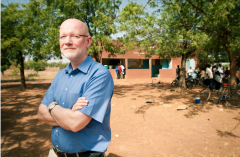
By Christopher J. Elias, president and CEO of PATH
When news from the British Medical Journal emerged last week discrediting the notorious Wakefield study as “an elaborate fraud,” I expected a chorus of celebration from the vaccine community, but what I observed was relative silence. I suspect that if the news had instead given more credence to the spurious argument that childhood vaccinations cause autism, Wakefield’s supporters would have had a field day. Why then did members of our community choose not to shout this from the rooftops, and put to bed a debate that has gone on, frankly, for much too long?
In my role as the president and CEO of PATH, I have witnessed first-hand the power of vaccines in combating some of the world’s most nefarious diseases. Indeed, just last month, I stood in the streets of Ouagadougou—the capital of Burkina Faso in West Africa—as thousands of parents brought their children to be vaccinated against meningococcal A meningitis, the strain of the disease most destructive to people living in Africa’s 25-country meningitis belt. On that day, there were no debates about whether this safe and effective vaccine would cause more harm than good. On the contrary, there was only a palpable sense of hope that, at last, a century-old, debilitating and deadly disease would finally be eliminated.
What we so often take for granted in the developed world is our right to choose and, in this instance, choosing whether to vaccinate our children. Conversely, in the developing world, one’s choices are much more curtailed. Even when a vaccine does exist, reaching the people who need it most is challenging, given the many obstacles in poor countries to accessing care. So, when news spreads in developing countries that there might be a solution to prevent pertussis, a disease which kills almost 300,000 people every year, the only question is will my child be able to get it.
For more than 30 years, PATH has been a part of some impressive breakthroughs in vaccine development and delivery. What we’ve learned throughout this time is that vaccines are the most successful and cost-effective public health tools we can employ to save lives, particularly among the world’s children. Vaccines are responsible for preventing more than 2 million deaths each year. Complacency or hesitancy about vaccination, however, can cause diseases previously thought to be eliminated to reemerge. In the aftermath of the Wakefield study we saw the reemergence of measles, which became endemic in England and Wales in 1998.
Perhaps the silence within our community occurred because the repudiation of the Wakefield claims seemed so obvious to us. We knew that when it comes to the link between vaccines and autism, the science has never wavered—there simply is no proven connection. But we need to appreciate how easily fraudulent or suspect science can influence public perceptions and political support. When “junk science” has the power to drown out the evidence, we have to use our voices to keep the focus on the real science. After 13 years, it seems that vaccines are finally vindicated. This important moment certainly calls for celebration, but also for reflection. One man’s fraudulent assertions in a respected medical journal led to a flurry of needless infections and deaths, not to mention a black eye on one of the world’s most successful public health interventions. While we hope that such a tragedy never happens again, we need to be ready for it if it does. Silence is no longer an option.
Christopher J. Elias is president and CEO of PATH, an international nonprofit global health organization. He also serves as the co-chair of the Decade of Vaccines Collaboration steering committee and secretariat, which aims to develop a global action plan to help research, develop, and deliver vaccines to the world’s poorest countries.