
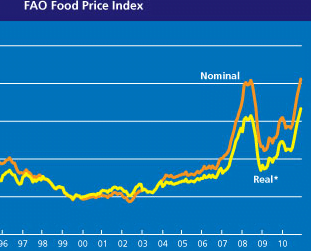
In the next few days, the Food and Agriculture Organization will release its monthly Food Prices Index, which measures the changes in price for a “basket” of food staples, like wheat, sugar, dairy products, cooking oil, and meat. December 2010 was the highest index score on record, surpassing June 2008 when riots over high food prices broke out in several countries around the world.
Now, says the FAO, the January 2011 Index may be very near the December 2010 record peak.
 So what does this chart have to do with the riots in Egypt? Several commentators have noted that the high price of food staples contributed to the overall feeling of discontent in Tunisia. There have already been protests over the sharp increase in food prices in Jordan earlier this month. Reading the writing on the wall, the Algerian government even put in a huge rush order of wheat.
This is not to say this is the cause of the civil unrest in Egypt today. But these questions of political economy really cannot be ignored when trying to understand the protests across the Middle East and North Africa. If this trend in the Food Prices Index continues, it is not unreasonable to expect that civil unrest will spread to several other countries.