
UPDATE – See bottom of post for The New York Times’s public editor’s response to our query.
UDPATE II: Because of our intervention, the New York Times issued a pretty stunning correction yesterday. It is reprinted in full, below.
Correction: February 1, 2011
The video “Southern Sudan’s Referendum” accompanying this article originally included an interview with a woman in Abyei. But that interview was removed after it was discovered that the English translation of her remarks in Arabic did not match the statement she made in the video clip. The subtitles, in which she described how her house had been burned, family members killed and belongings stolen, stemmed from an earlier interview. But in her remarks on the video, she described her financial difficulties instead.
Viewers alerted The Times to the discrepancy, which arose from a miscommunication with the translator. In a follow-up interview with the woman, it was discovered that the translator had also misstated her surname and misidentified a relative she said had been killed. She is Sarah Ahmed, of the Hamer tribe, not Sarah Hamer; and she said a cousin had been killed, not her son.
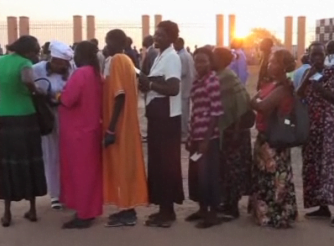
Original post: The New York Times’ Jeffrey Gettleman is covering the historic referendum taking place in South Sudan. To this end, he traveled to Abyei, a town located on the disputed border and is the scene of ongoing ethnic clashes between Misseriya and Dinka to document the current. In Abyei, Gettleman speaks to a few local people, asking them about how the violence in their area is affecting their lives, and what they think the future holds.
You can view the video here: Southern Sudan’s Referendum
What you will not see, however, is a short clip with the testimony a middle-aged woman which was removed from the video a couple of days ago. Why? As is the case with a couple of other testimonies in the video, the woman being interviewed was speaking in Sudanese Arabic – a very common language in Sudan – and the Times placed English subtitles above the image. Except, it turns out that what this woman was actually saying had absolutely nothing to do with what the subtitles were claiming.
The video has been edited since, so you’ll have to take my word for it. This came to my attention through a friend of mine, Sara Elhassan, a Sudanese who is currently working for a large international organization out of Khartoum. She posted the original video on her Facebook page with a message saying:
The New York Times , I liked your FB page today so I could put you on blast about your video report entitled ‘Southern Sudan’s Referendum’. How dare you blatantly mistranslate that lady’s testimony? While she was complaining about the raise in prices of sugar and its effect on her business, your subtitles made her talk about her s…upposed “anger” over her “dead son” and “burned home” You should be ashamed.
Friends began responding to this post, in disbelief over the Times‘ carelessness and irresponsibility. Since then, the misleading clip was removed from the video.
In an email exchange with me, Elhassan notes, “When I went back to re-watch the video just now, I found that they cut out the clip of the lady (I guess in response to my friend’s email). But anyway, I was so furious with this article that I memorized her testimony; the woman in the clip was saying: ‘the prices of sugar have gone up, and it’s making it hard … you’re asking me about making a living, right? everything is so expensive, customers don’t even come anymore. Besides you guys, nobody’s been sitting in those chairs…’ The subtitles, though, were saying something along the lines of ‘The clashes (between Dinka and Misseriya) have made it very dangerous here. They killed my son and burned our home. I am very angry over the death of my son.'”
I understand that the Times wanted to tell a story, and perhaps the reporter spoke to this woman prior and she did in fact tell him those things about a burned-down house and a dead son. Nevertheless, the misleading – blatantly false – subtitles are unacceptable.
Mark has submitted this post in a letter to the Times Public Editor to see if we can get to the bottom of this. I will post any response that I receive.
UPDATE, January 28, 2011: See below for The New York Times Public Editor Art Brisbane’s response. We’ll update again when we we hear any further news:
I have had a chance to follow up further with the Foreign Desk about the Sudan video. Here is what I can tell you at this stage. According to Susan Chira, the foreign editor, a pre-interview with the Sudanese woman was conducted in which she talked about a dead son. In the actual interview, which was recorded, she did not speak of the dead son but the translator referred to the dead son in compressing material from the pre-interview into an explanation of the background. The subsequent questions raised about the recorded interview and its translation have prompted the Times now to hire an independent translator to go to Abyei, find the woman and reinterview her. The foreign desk has told me they will be back in touch as soon as they hear the results of this. At that time, I would be happy to update you further.
UPDATE II: February 2, 2011: Because of our intervention, the New York Times issued a pretty stunning correction yesterday. It is reprinted in full, below.
Correction: February 1, 2011
The video “Southern Sudan’s Referendum” accompanying this article originally included an interview with a woman in Abyei. But that interview was removed after it was discovered that the English translation of her remarks in Arabic did not match the statement she made in the video clip. The subtitles, in which she described how her house had been burned, family members killed and belongings stolen, stemmed from an earlier interview. But in her remarks on the video, she described her financial difficulties instead.
Viewers alerted The Times to the discrepancy, which arose from a miscommunication with the translator. In a follow-up interview with the woman, it was discovered that the translator had also misstated her surname and misidentified a relative she said had been killed. She is Sarah Ahmed, of the Hamer tribe, not Sarah Hamer; and she said a cousin had been killed, not her son.